A Climate, Energy, and Air Quality EJ Community Engagement and Policy Guide for Local Governments
The Challenge
Updating the Environmental Justice Toolkit required more than revising a 2017 document, it meant responding to the evolving climate, energy, and air quality concerns facing communities across the Metro Washington Council of Governments (MWCOG) region. Equnival’s role was to ensure that the Toolkit 2.0 reflected the key issues communities in the MWCOG were experiencing, grounded in robust community engagement, listening sessions, and research with local leaders. The result is a resource designed to strengthen meaningful engagement, advance equity, and support more just and resilient local climate action.
Our Approach
Local Leader Outreach:
Equnival led a multi-phase engagement process in Spring 2025, using MWCOG’s EEA tool to identify priority communities and conduct three rounds of interviews, small group discussions, outreach events, and advisory committee sessions with 44 community leaders across Maryland, DC, and Virginia. In parallel, MWCOG convened two local government listening sessions with the MWCOG Air and Climate Public Advisory Committee members with outreach and sustainability staff from across member jurisdictions to identify best practices, persistent challenges, and emerging needs in engaging underserved communities. Together, these efforts ensured the Toolkit reflects both community-rooted insight and practical implementation experience from local governments.
Equnival partnered with the Metropolitan Washington Council of Governments (MWCOG) to understand key issues of concern for their jurisdictions, as well as connect with stakeholder groups in the community to ensure that all 24 county perspectives, but particularly the 12 counties with Equity Emphasis Areas (EEAs), across Maryland, DC, and Virginia were represented.
Findings and Recommendations
Our engagement process revealed a clear disconnect between formal public engagement meetings that are routine for local governments and hyperlocal, relationship-based engagement that is more valued by communities. Community leaders emphasized that trust is built through consistent, in-person presence, partnerships with trusted intermediaries, and information that is localized; data that not only describes impacts, but helps residents take action. At the same time, many community-based organizations reported limited capacity and staffing to sustain engagement, often limiting their participation to public comment rather than ongoing collaboration, which they recognize is valuable. Recommendations focus on engaging early and often, leveraging existing community networks, prioritizing face-to-face communication, and supporting community-led decision-making through transparent, two-way data sharing. The findings also underscore MWCOG’s unique opportunity to use its convening power, data expertise, and regional relationships to build consensus, strengthen community capacity, and foster more equitable climate and energy policy outcomes.
Toolkit 2.0
The Environmental Justice Toolkit 2.0, integrated Equnival’s community-based research with the other learning being led by MWCOG since the release of the prior Toolkit. Environmental justice communities identified air quality, intensifying heat islands and flooding, and equitable access to EV infrastructure, rooftop solar, and other clean energy as their top climate and energy concerns. The rapid expansion of AI and data centers is expected to heighten these challenges, bringing additional impacts related to land use, water and energy demand, backup generator emissions, noise, and rising electricity costs that increase pressure on household energy affordability. Since the 2017 Toolkit, COG members have made meaningful progress integrating equity into climate and energy planning, yet barriers to participation, such as language access, childcare, youth engagement, and sustained funding, remain. Strengthening long-term relationships with trusted community partners and investing in local capacity will be critical to overcoming these obstacles. As a regional convener, MWCOG can play a crucial role by connecting governments, nonprofits, and community leaders to share resources, elevate best practices, and advance more equitable and resilient climate solutions.
Explore the Work
Read the Full Report

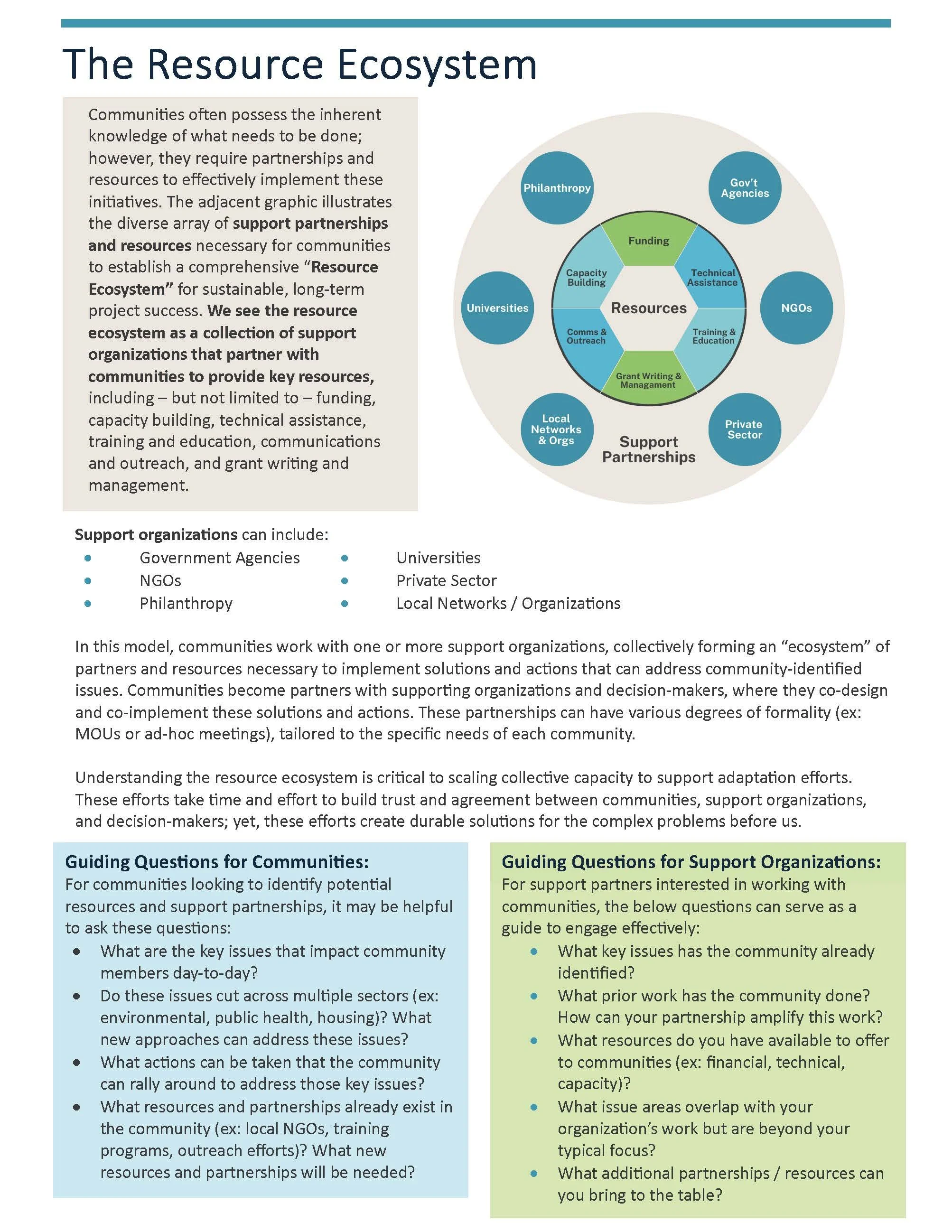
Learn more about the Resource Ecosystem framework →